
The Survival Guide: 7 Signs Your "Personality Quirks" Are Rooted in Trauma

7 Signs Your Hyper-Independence Is a Trauma Response, Not a Personality Flaw
The Exhaustion of Being "So Capable"
You know the type. The “strong friend”, the one who holds it all together.
The one that is so capable… able… willing.
But did you ever stop to think why they are so capable.
And that they may be over-compensating and exhausted AF.
June is PTSD Awareness Month and I want to acknowledge this not by just raising awareness but by shifting the focus away from stereotypical, cinematic depictions of trauma.
I am talking to the millennial woman who feels exhausted by her own mind.
We often judge some of the attributes that I am talking about as as character flaws or "quirks".
Things like over-explaining, struggling to relax, or refusing help.
These things are actually brilliant, adaptive survival strategies our bodies and our minds developed to keep us safe.
The Neurobiology of Survival
The Nervous System
When our bodies have survived historical or relational un-safety, our nervous systems adapt brilliantly to protect us. Think of your brain’s fear center like an ultra-sensitive smoke detector. If you grew up in a chaotic environment or navigate a world that constantly questions your worth, that internal alarm gets stuck in the "on" position. Your brain isn’t malfunctioning; it is doing exactly what it was designed to do like scanning the room, reading the energy, and bracing for impact. It learned that hyper-vigilance was the only way to survive. Living in chronic survival mode leaves you utterly exhausted, even when you are technically safe.
The "Fawn" and "Flight" Responses
We often hear about "fight or flight" as if we are outrunning a physical threat, but modern trauma responses look much different. For many of us, "flight" isn’t sprinting away; it is throwing ourselves into our careers. It is that relentless perfectionism and overachieving so you never have to sit still and feel the vulnerability bubbling underneath. Then there is "fawning" the survival strategy we rarely name. Fawning is chronic people-pleasing. It is shrinking your voice and frantically managing everyone else’s emotions to keep the peace. You learned early on that abandoning your boundaries was the fastest way to stay safe.
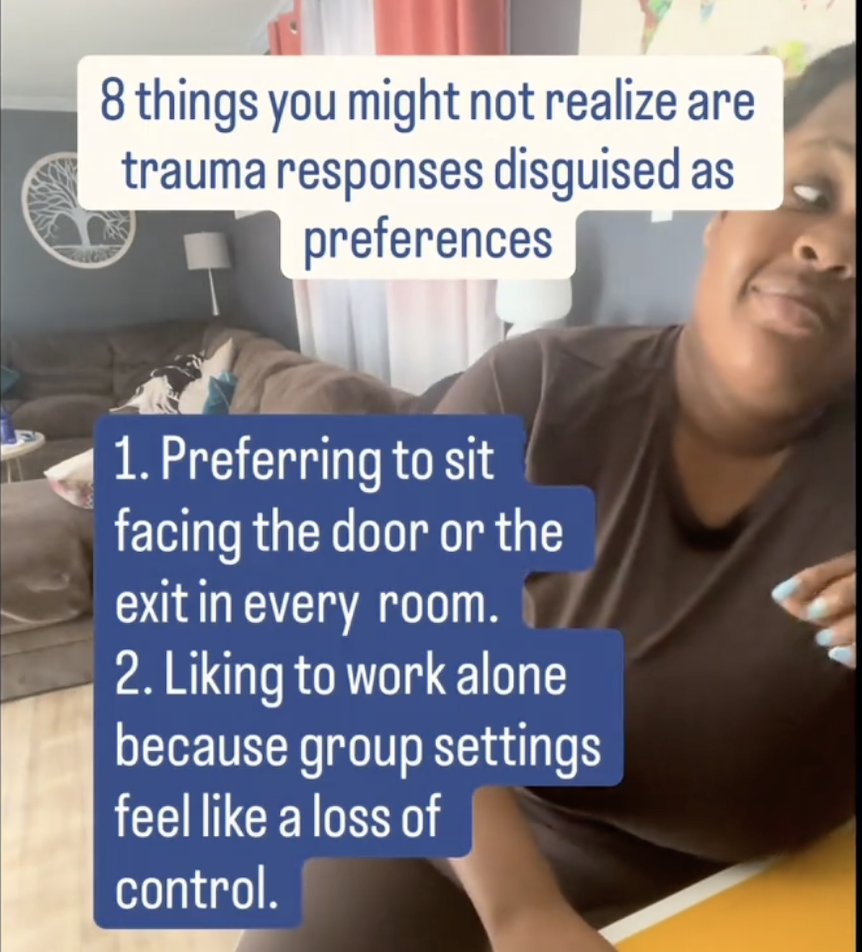
Check out this social media post:
“8 Things You Might Not Realize are Trauma Responses Disguised as Preferences”
POV: Realizing your personality “quirks” are actually survival strategies heavy. These trauma responses go unnoticed because society praises women, especially Black women for being hyper-vigilant, “low maintenance,” and fiercely independent.
The 7 Signs Your "Personality Quirks" Are Rooted in Trauma
Hyper-Independence: Refusing to ask for help because past experiences taught you that relying on others is unsafe or comes with manipulative strings attached.
The "Guilt of Resting": The physical inability to just sit on the couch. Your sympathetic nervous system is stuck in overdrive, associating "stillness" with "danger."
Preemptive People-Pleasing: Managing everyone else's emotions in the room before they even have a chance to get upset, ensuring your environment remains stable.
Shutting Down in Minor Conflict: The "freeze" response. Your mind goes completely blank when someone is upset with you, making it impossible to communicate.
Assuming the Worst (Hypervigilance): Reading into every sigh, text punctuation, or tone shift as a sign that you are about to be abandoned.
Apologizing for Existing: Saying "I'm sorry" for things completely out of your control, operating from a core belief that you are inherently a burden.

Gently Changing the Pattern Without Shame
Awareness is the First Step: You can begin to take notice of the bodily sensations like a tight chest, racing heart, or racing thoughts before the behavior starts.
Self-Compassion: Swapping the "Why am I like this?" thoughts with "Of course my body is reacting this way, but I am safe now."
Somatic Grounding: Introduce one accessible, low-barrier grounding tool to use when triggered.
Learning Your Patterns: Engaging in professional counseling for therapeutic support to understand the “why” behind the feelings.
Begin to Thrive Instead of Just Survive
At AWA Counseling, we know how exhausting it is to carry the weight of the world, and we believe you shouldn't have to do it alone anymore. We are proud to be a premier, culturally-affirming practice dedicated to the healing, rest, and liberation of Black and Brown folks, women, and cycle-breakers.
We specialize in compassionate therapy for millennial women navigating high-functioning trauma and burnout. Whether you need a dedicated space just for yourself, want to heal alongside your partner, or are looking to find your village, our expert clinical team is here for you. We offer:
Individual, Couples, and Group Therapy tailored specifically to your lived experiences and relational goals.
Accessible Online Care across PA, DE, and VA, so you can heal from the comfort of your own safe space.
A Gentle, Attuned Approach equipped with real tools to help you build safety, connection, and radical self-trust.
We also believe that high-quality, culturally competent care should be accessible. To help make your healing journey as seamless as possible, we proudly accept some major commercial insurances and partner with various EAP (Employee Assistance) programs.
If you’re ready to finally put down the armor and get the support you deserve, visit our Individual Therapy page to learn more about our approach, or contact us today to set up an appointment. We've got you.